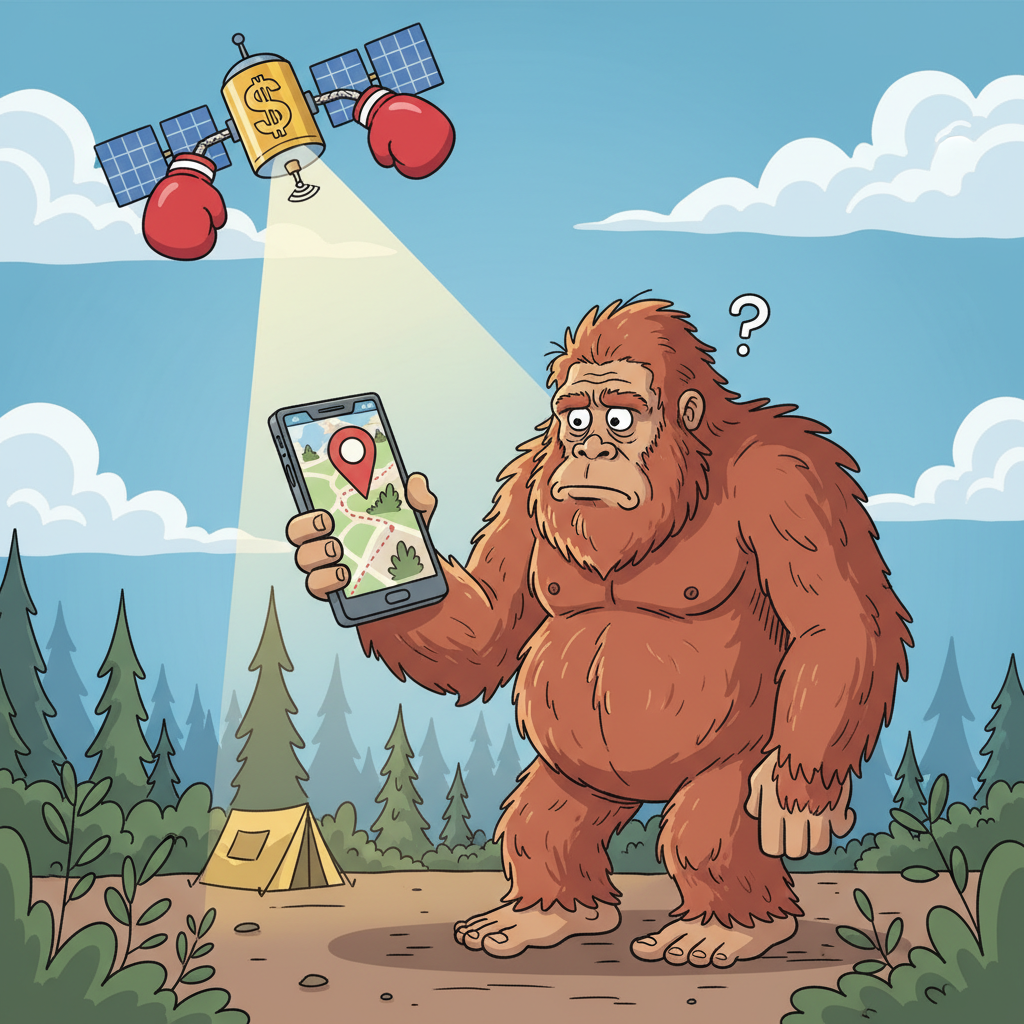
Oh, you thought that little blue dot on your map that guides you to the nearest artisanal avocado toast dispensary just… worked? How delightfully naive. Allow me to pull back the curtain on the glorious, taxpayer-funded spectacle that is the GPS III program, a little something the U.S. Space Force and Lockheed Martin have been cooking up.
They’re rolling out a new fleet of satellites, you see. And they promise your life is about to get so much better. Or at least, more precise.
For You, the Humble Peasant
For the low, low price of absolutely free (terms and conditions apply, see: national budget), you get a reported 3x better accuracy. Tremendous. Now, when you inevitably drive into a lake following your phone’s directions, you can be sure it’s the exact spot the satellite intended. According to the marketing materials, this newfound precision will finally allow you to pinpoint Bigfoot’s front door. A noble goal for science, I’m sure. They’ve also included a new “L1C civil signal” so it can play nice with other countries’ satellite systems, because interstellar friendship is magic. (Source: U.S. Space Force, Lockheed Martin)
These orbiting marvels also boast a 15-year design life, a solid 25% longer than the old models. A stunning leap in longevity for something that costs more than a small country’s GDP. Who wants to replace their multi-million dollar space gadget every other Tuesday, right? (Source: ION.org)
For Them, the “Real” Customers
But let’s be honest, this isn’t about helping you avoid traffic. The real bells and whistles, the premium subscription features, are for the military. We’re talking up to 8x improved anti-jamming capabilities, with a future “Block IIIF” promising a mind-boggling 60x greater resistance. (Source: Air & Space Forces Magazine, esd.whs.mil) This is for when an adversary tries to mess with the signal, ensuring the delivery of… ‘freedom’… is never interrupted.
And there’s more! Stronger signals, cyber-hardened systems, regional spot beams that are 20 dB stronger, and even a casual add-on for nuclear detonation detection. You know, just in case. It’s all part of what they call “peace of mind through enhanced orbital vigilance.” I feel more peaceful already, don’t you? (Source: Wikipedia – GPS Block III)
Let’s Talk Money (Try Not to Weep)
Now for the fun part: the bill for this “free-to-you” service. Please place your head between your knees if you feel faint.
- The contract for just two of these satellites (numbers nine and ten) was a cool $395 million. That’s not including the Uber fare to orbit. (Source: Wikipedia – GPS Block III)
- That Uber fare? A single SpaceX launch to deliver one of these bad boys was priced at $82.7 million a few years back. (Source: Wikipedia – SpaceX)
- And my personal favorite: the ground control system. You know, the part that actually flies the multi-million dollar satellites? It faced “significant delays” and came in approximately $4 billion over budget and over 8 years behind schedule. A true masterpiece of efficiency. (Source: Wikipedia – Global Positioning System)
So, the next time you use your “free” map, remember that the invisible backbone holding it up is deemed critical for “lethality and resilience” in military operations. (Source: U.S. Space Force) Your ability to find a gas station is just a happy, and mind-bogglingly expensive, little byproduct.
Sources: The Facts Behind the Sarcasm
- U.S. Space Force – Accelerated GPS III Mission
- Lockheed Martin – GPS III/IIIF
- ION.org – GPS III Product Card
- Wikipedia – GPS Block III
- Air & Space Forces Magazine – Push for Resilient PNT
- Selected Acquisition Reports – GPS IIIF SAR DEC 2022
- Wikipedia – SpaceX
- Decatur Daily – SpaceX National Security Launch
- Wikipedia – Global Positioning System
Leave a Reply