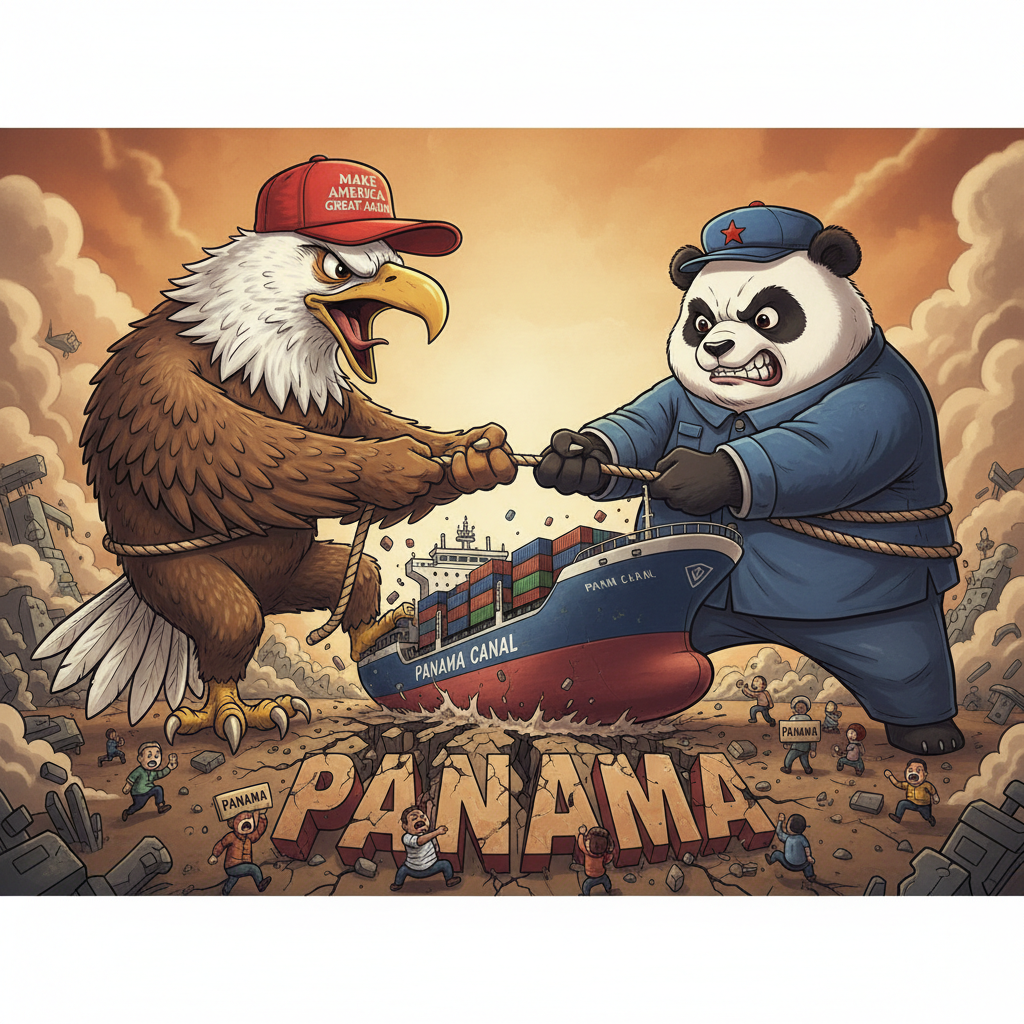
Gather ’round, folks, for a heartwarming tale of national sovereignty! In a move that totally wasn’t influenced by anyone, the Panama Supreme Court has heroically decided that a major port concession is unconstitutional. The fact that the concession was held by a company with Chinese ties and that the United States is cheering wildly from the sidelines is, of course, a complete and utter coincidence.
A Principled Stand… For Someone Else’s Principles
The court, in its infinite wisdom, declared that the port concession held by a subsidiary of Hong Kong’s CK Hutchison Holdings violated Panama’s constitution [1]. While they were a bit fuzzy on the exact* legal articles, thankfully, US Secretary of State Marco Rubio was on hand to translate. He graciously explained that the ruling was really about preventing Beijing from using the ports as “chokepoints” that could threaten American interests [1, 2]. It’s always so helpful when a foreign politician can explain your own country’s sovereign legal decisions to you.
Nothing to See Here, Just a Geopolitical Coincidence
This whole drama has been simmering for years. Critics, most of whom happen to reside in Washington D.C., have been clutching their pearls ever since the Hong Kong-based firm secured the contract to operate ports at both the Pacific and Atlantic ends of the Canal. They feared the “Chinese-linked control” over this vital trade asset [1].
Now, in a stroke of what can only be described as miraculous timing, this ‘principled’ legal decision conveniently clears the path for a pending $22.8 billion sale of the ports to a consortium led by none other than US-favored BlackRock. That deal had been mysteriously stalled, you see, following some grumbling from China [2]. It’s just amazing how the wheels of justice turn to grease the wheels of multi-billion-dollar, geopolitically convenient sales!
Don’t Worry, It’s Only Global Trade
While Washington pops the champagne to celebrate this “victory” for… freedom? capitalism? an eagle-themed world order?… the Panamanian government is left trying to reassure everyone that this won’t cause any pesky “uncertainty” for international investors or local workers [1].
And you, dear consumer, should pay no mind to the fact that about 5% of all worldwide maritime trade passes through these ports. I’m sure that booting a hyper-efficient, globally connected operator and navigating a prolonged legal battle will have absolutely zero impact on global supply chains or shipping costs. Everything is fine [1, 3].
So, what have we learned? We’ve learned that in the grand global soap opera, some countries are the dramatic stars, and others are just the set. This ruling is a clear win for the US strategy to counter China’s “Belt and Road” initiative, and a fantastic reminder that when giants fight, the grass they trample on should probably just be grateful for the attention.
Leave a Reply