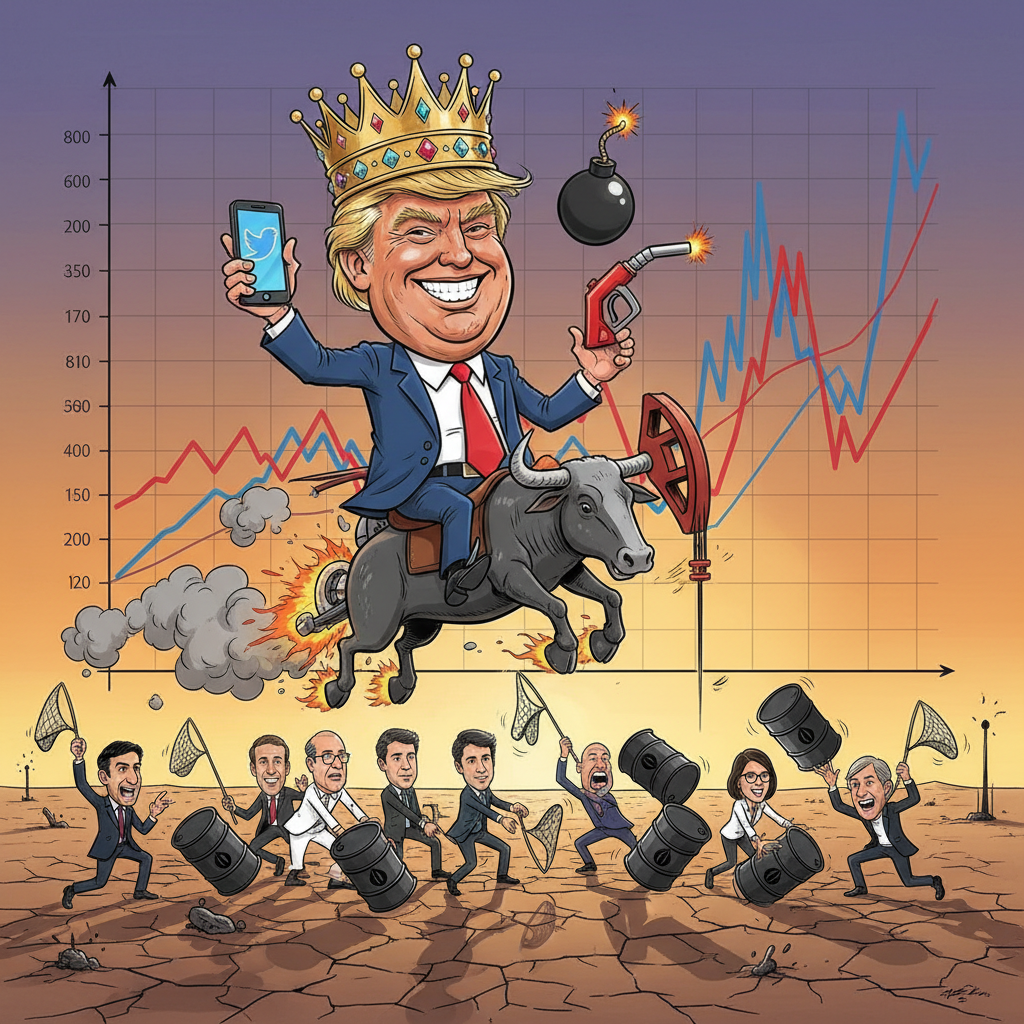
Gather ’round, children, and let’s recount the tale of early March 2026, a time when global leaders decided to play a rousing game of “Let’s See Who Can Terrify the Oil Market the Most.” Spoiler alert: everyone was a winner in this spectacular display of causing worldwide economic stress.
Step 1: Start a Panic (It’s Easy!)
First, you’ll need some good old-fashioned geopolitical tension. A dash of military action in the Middle East involving the U.S., Israel, and Iran should do the trick. The moment Tehran claimed it fired a missile at a U.S. oil tanker, the market predictably lost its mind. Brent crude flirted with $120 a barrel, the highest in about four years, which is finance-speak for “your gasoline is about to get really, really expensive.” (Source: The Guardian, The New York Times) The world suddenly remembered that a tiny waterway called the Strait of Hormuz is responsible for about 20% of the world’s oil supply, and maybe, just maybe, putting explosive devices in it is bad for business. (Source: The Guardian, CNBC)
Step 2: Add “Reassuring” Leadership Commentary
When the markets are in a freefall, what they truly need is a steady hand. Or, alternatively, a leader who says he has a “plan” that’s “ahead of schedule” and will end “very soon,” while simultaneously vowing to bomb the other side “at a much, much harder level.” (Source: CBS News, Bloomberg) President Trump masterfully played both sides, suggesting that $100-a-barrel oil was a “small price to pay” for peace. How comforting for everyone who has to, you know, buy things. (Source: The New York Times) This symphony of mixed messages created what Bloomberg generously called “extraordinary and acute stress.” You don’t say?
Step 3: Governance by Social Media
To really accelerate the chaos, ensure your high-ranking officials are active on social media. For a beautiful, fleeting moment, oil prices plummeted after Energy Secretary Chris Wright tweeted that the U.S. Navy had escorted a tanker through the Strait of Hormuz. The only tiny problem? It hadn’t happened. The post was deleted, but the market’s whiplash was permanent. (Source: Bloomberg) Truly, a masterclass in crisis management.
Step 4: Let the Adults (Try to) Clean Up
While one part of the world was tweeting its way through a potential war, the Group of Seven (G7) nations decided to have a meeting. French President Emmanuel Macron, holding the G7 presidency, bravely announced that “the use of strategic reserves is an envisaged option.” (Source: Fortune) The sheer audacity! Envisaging things! The International Energy Agency (IEA) even proposed a record release of oil reserves, presumably to pour a bit of calm on the raging inferno of the global markets. (Source: Euronews) Their coordinated effort to *consider* doing something was enough to make prices slightly less insane, proving that sometimes the mere appearance of adult supervision is enough.
So, what did we learn from this historical episode? We learned that geopolitical stability is a quaint, outdated concept from a bygone era. We learned that the difference between cripplingly expensive oil and just moderately expensive oil can be a single, ill-advised tweet. And most importantly, we learned that when the world is on fire, it’s reassuring to know our leaders have a “plan.”
Sources: The Facts Behind the Sarcasm
Because unlike some people, I don’t make things up.
- Washington Post: Biden grapples with mixed signals on Iran, oil prices fluctuate, March 9, 2026
- The New York Times: As Oil Prices Rise, the War With Iran Becomes a Worldwide Economic Hazard, March 9, 2026
- The New York Times: After Global Economy Shudders, Trump Zigzags on Whether War Is Nearing End, March 9, 2026
- NBC News: ‘Most intense day’ of U.S. strikes on Iran, Hegseth says; Tehran warns it will block oil until attacks end, March 11, 2026
- CBS News: As U.S.-Israeli war with Iran intensifies, Trump says it is “very far ahead of schedule”, March 10, 2026
- The Guardian: US stock markets close on high after Iran war drove oil prices above $100 a barrel, March 9, 2026
- CNN Business: Oil prices dive as Trump says Iran war will end ‘very soon’, March 10, 2026
- Bloomberg: Trump Hears Markets’ Fears About Iran War, Oil Prices, March 10, 2026
- Bloomberg: Trump officials’ mixed Iran messages prompt more volatility, March 10, 2026
- The Japan Times: Trump officials’ mixed Iran messages prompt more volatility, March 11, 2026
- Bloomberg: Iran War: Trump Insists ‘I Have a Plan’ as Oil Prices Surge, March 9, 2026
- Fortune: Oil price moderates after Macron, as leader of G7, confirms ‘the use of strategic reserves is an envisaged option’, March 9, 2026
- Euronews: Oil steadies as IEA and G7 move to release record reserves, March 11, 2026
- The Guardian: US attacks Iran’s mine-laying boats in strait of Hormuz as tensions rise over oil, March 11, 2026
- CNBC: U.S. forces sink 16 Iranian minelayers as reports say Tehran is mining the Strait of Hormuz, March 11, 2026
- CNBC: Iran sends millions of oil barrels to China through Strait of Hormuz even as war chokes the waterway, March 11, 2026
- The New York Times: Oil Prices Will Remain High as Iran War Continues, March 9, 2026
- The Independent: Iran-US war latest: Ships attacked in Strait of Hormuz after US attacks mine-laying vessels, March 11, 2026
- Wikipedia: 2026 Strait of Hormuz crisis
Leave a Reply