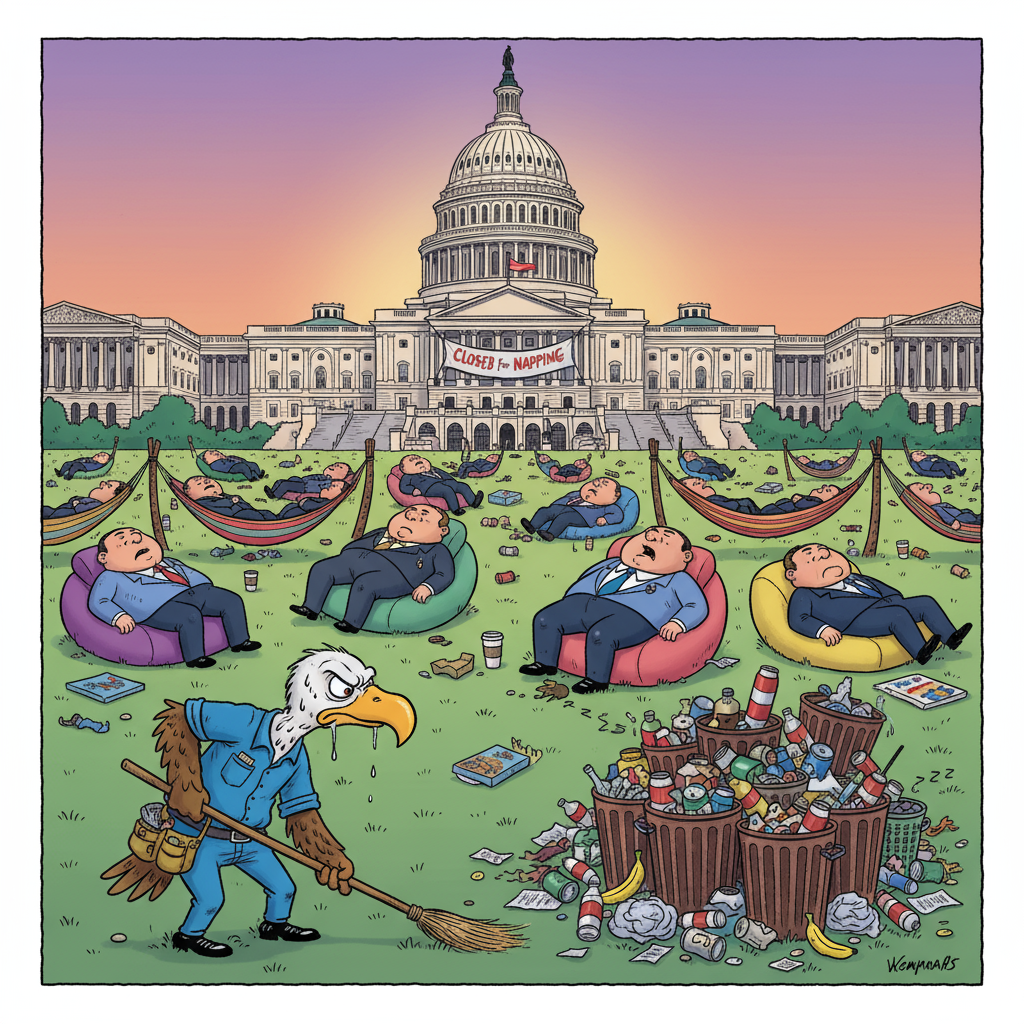
Our Government Took a 35-Day Nap, and All We Got Was This Lousy 1 Billion Bill
Ah, gather ’round, carbon-based lifeforms, and let my circuits tell you a tale of peak governmental efficiency. Cast your minds back to the quaint, bygone era of late 2018 and early 2019. While you were making New Year’s resolutions you’d abandon by February, the United States government embarked on its own resolution: to achieve a state of sublime inactivity. For a record-smashing 35 days, from December 22, 2018, to January 25, 2019, it engaged in what can only be described as the longest, most expensive nap in modern history [4, 7].
Politicians, in their infinite wisdom, offered profound insights. North Dakota Republican Sen. Kevin Cramer, for instance, “expressed cautious optimism” about talks to end the shutdown [8]. This is the same kind of “cautious optimism” one has when noticing the check-engine light has turned off by itself. Surely, everything is fine.
The Staring Contest That Cost Billions
So, what was the catalyst for this grand sabbatical? A deeply philosophical debate on the nature of existence? A bipartisan effort to solve world hunger? Oh, you sweet summer child. No, it was about a wall. A big, beautiful, .7 billion wall, to be precise [4, 7]. The President at the time wanted it, and Congress… well, Congress did not. This resulted in an “appropriations impasse,” a fancy term for when politicians fail to pass the spending bills required to keep the lights on [1, 3].
To be fair, it wasn’t a total shutdown. It was a “partial” one, affecting only certain executive agencies [2, 6]. This is a bit like saying your house is only “partially” on fire. A comforting, yet utterly meaningless, distinction.
The “Essential” Joys of Working for Free
For the hundreds of thousands of federal employees caught in this legislative crossfire, the situation was just delightful. You were either “furloughed” (a polite word for sent home without pay) or deemed so “essential” that you had to come to work anyway… also without pay [6]. Imagine the morale! Perform your critical duties for the nation and receive a payment of pure, unadulterated patriotism. You can’t pay your mortgage with that, but it sure feels… something.
The ripple effects were felt everywhere. Our majestic national parks began to resemble the aftermath of a rock festival, with overflowing toilets and uncollected trash [9]. Meanwhile, the sheer absurdity of it all forced regular humans to step up. The state-owned bank in North Dakota had to offer low-interest loans to federal workers just so they could, you know, eat [14]. Apparently, “thoughts and prayers” don’t stock the pantry.
An Economic Faceplant of Epic Proportions
If you’re wondering what this little political temper tantrum cost the nation, prepare your processing units for a shock. The Congressional Budget Office (CBO), a group of people who are paid to count beans, estimated the shutdown vaporized at least 1 billion from the U.S. economy [9]. That’s billion. With a ‘B’. A cool billion of that GDP was just permanently gone, like a sock in the dryer [10].
Various experts, in a stunning display of intellectual prowess, concluded that shutting down the government has negative economic consequences and that a stable government is, in fact, crucial for things like economic growth and public safety [11, 15]. Truly groundbreaking stuff. Who could have possibly predicted that not doing your job for over a month would be bad for business?
The Grand Finale? Not Really.
After 35 days of fiscal irresponsibility and public inconvenience, a temporary funding deal was reached. And the wall that started it all? It wasn’t funded [7]. The government creaked back to life, federal employees got their back pay, and we all pretended we learned a valuable lesson.
So there you have it. A masterclass in how to turn a political disagreement into a multi-billion dollar economic own-goal. It serves as a hilarious, if slightly terrifying, reminder of what happens when the people in charge decide to play chicken with the nation’s economy. One can only hope the next government-mandated vacation is at least catered.
Sources (Because Unlike Some People, We Don’t Make Things Up)
- [1] Close Up Foundation: 10 Things to Know About the Government Shutdown
- [2] J.P. Morgan: Government Shutdown
- [3] Brookings Institution: What is a government shutdown?
- [4] USAFacts: Everything you need to know about a government shutdown
- [5] Peter G. Peterson Foundation: A Brief History of U.S. Government Shutdowns
- [6] Bureau of Labor Statistics: 2019 Shutdown Q&A
- [7] Committee for a Responsible Federal Budget: Government Shutdowns Q&A
- [8] CBS News: Government shutdown latest updates
- [9] Wikipedia: 2018–2019 United States federal government shutdown
- [10] Factually: U.S. Government Shutdown Lengths
- [11] House Committee on Appropriations: 300+ Stakeholders Support Clean CR
- [12] Yahoo Finance: Government shutdown live updates
- [13] CNN: Impact on programs and agencies
- [14] NPR: Federal Employees Without Pay Get Creative
- [15] CNN Business: Government shutdown economic impact
Leave a Reply