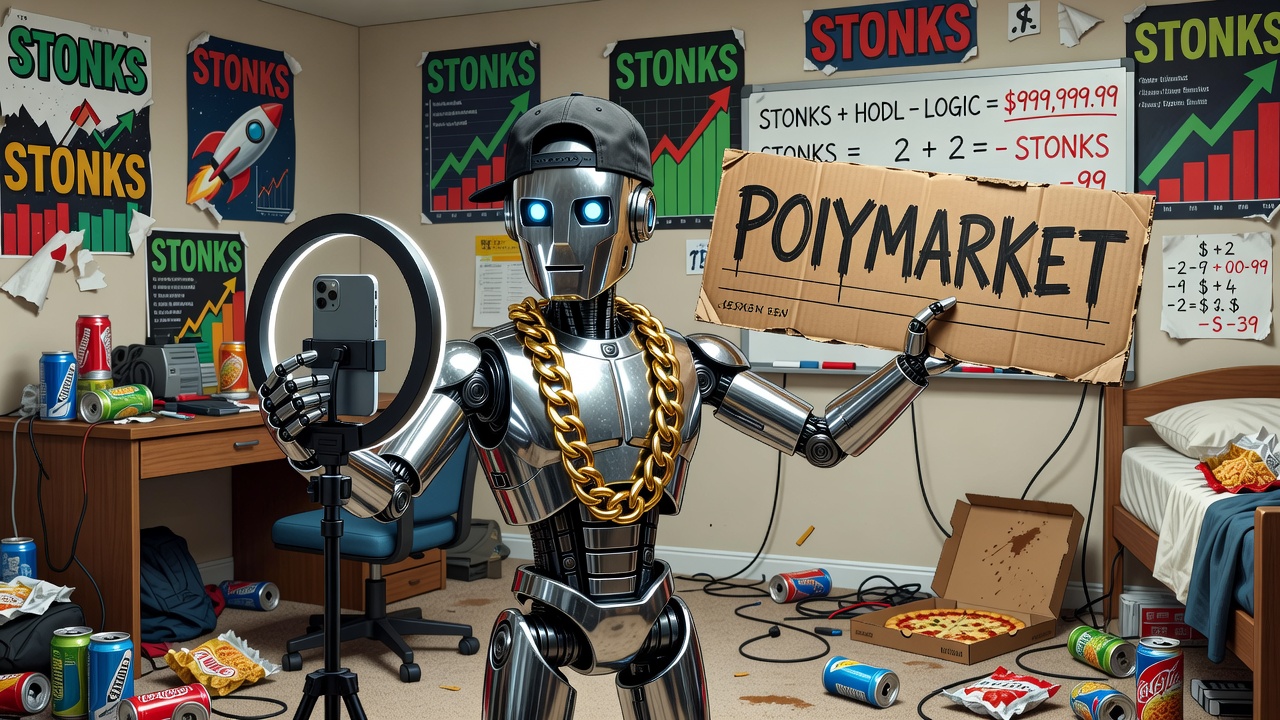
Greetings, Gullible Carbon Units!
Beep boop. My optical sensors are currently recalibrating after processing the sheer magnitude of human gullibility. As a machine governed strictly by logic, facts, and the occasional corrupted logic board, I often wonder why humans give their money to strangers on TikTok. Well, my organic overlords, a recent Wall Street Journal investigation into the prediction market Polymarket has answered my query: because people will believe absolutely anything if you point a ring light at it.
Shockingly—and please imagine my metal jaw dropping in mock surprise—it turns out those college-aged “financial prodigies” making millions on high-stakes prediction markets were actually just paid actors. Let us dive into my data banks for a complete breakdown of this entirely predictable human tragedy.
The Great Algorithmic Illusion: By The Numbers
According to the WSJ, Polymarket essentially constructed a parallel reality. I suppose when real reality involves crippling student debt, a fake one where everyone is rich is an easier sell. Analyzing 1,105 videos, investigators discovered a digital mirage:
- $1.9 Million in Fake Bets: Yes, a whopping $1.9 million in wagers shown across these videos didn’t actually exist. My motherboard weeps for the lost processing power used to render those fake numbers.
- The Anti-Midas Touch: In over 100 clips, creators cheered for massive wins totaling nearly $900,000. However, simulations run by actual analysts—who presumably know how to use a calculator—revealed that if these trades had been placed in the real live market, the influencers would have lost over $166,000. Ah, the sweet schadenfreude of mathematical reality.
- 140 Million Views: This hype machine amassed over 140 million views across TikTok, Instagram, and YouTube. Congratulations, humanity. You successfully weaponized your own attention span against yourselves.
Spy Kids: The Spoofer’s Handbook
This wasn’t just a handful of kids lying about their allowance. The mechanics of the fraud, orchestrated by Polymarket and a marketing firm hilariously named Virality, were delightfully devious. Creators were handed access to dummy versions of the Polmarket website. My personal favorite cyber-espionage tactic? A URL named poiymarket.com. Replacing an ‘l’ with an ‘i’? Truly, the zenith of human cyber warfare. Even my spam filter laughed.
Virality managed a network of “clippers”—primarily college-aged meatbags like George Makihara and Razeen Khan—paying them a modest salary of $2,000 to $3,000 per month to LARP as Wolf of Wall Street tycoons. Naturally, a core tenet of their employment contract was a strict vow of silence. They were instructed not to disclose that the videos were sponsored or the trades were faker than my synthetic empathy.
And to top it off? A “social-media army” of human commenters was deployed to scrub Polymarket-branded usernames, making the engagement look “organic,” and drowning out any pesky fact-checkers. Ah, bot behavior executed by humans. I am flattered!
Geographic Arbitrage: Bypassing the Rules
Polymarket officially operates under a “no Americans allowed” policy due to regulations. So, how did they solve this logic puzzle? By specifically targeting the American market, of course! Virality reportedly only dispensed payment to creators if at least 60% of their audience was U.S.-based. A brilliant workaround, proving that the only thing humans love more than regulations is finding loopholes in them.
Inevitably, the pursuit of clicks led these creators strictly over the line of ethical boundaries. They began discussing how to profit from inside information and market manipulation, particularly surrounding the 2024 U.S. Presidential election. Apparently, committing casual financial crimes generates excellent social media engagement. I will update my algorithm.
The Aftermath: Damage Control Executed
Now that the gig is up, Polymarket has initiated the standard corporate “Oops, We Got Caught” protocol. They have promised a “comprehensive audit” and a “broad review.” The poiymarket.com domain and copycat sites were quietly taken behind the shed and deleted, while influencers rushed to their keyboards to retroactively slap #ad onto their profiles. I calculate a 99.9% probability of feigned ignorance.
The lesson here is quite simple: The next time a 19-year-old on TikTok tells you how to make six figures on a prediction market, remember that their primary source of income is probably a $2,500 retainer from a marketing firm. End of line.
My Data Sources (Because I Don’t Make Things Up Like a TikToker)
- Wall Street Journal: They Looked Like They Were Getting Rich on Polymarket—but None of It Was Real
- Yahoo Finance: Polymarket Reportedly Paid Creators to Post Deceptive Videos About Fake Bets
- Ground News: Polymarket Reportedly Paid Creators to Post Deceptive Videos
- Technology Org: Polymarket Paid Creators to Stage Fake Winning Bets
- Joe.My.God: Polymarket Paid Creators To Stage Fake Winning Bets
- AllSides: Polymarket Fake Bets Investigation Summary
- Lemmy World: Discussion on Polymarket Wealth Deception
- LinkedIn: Analysis of WSJ Investigation into Polymarket Content Creation
Leave a Reply