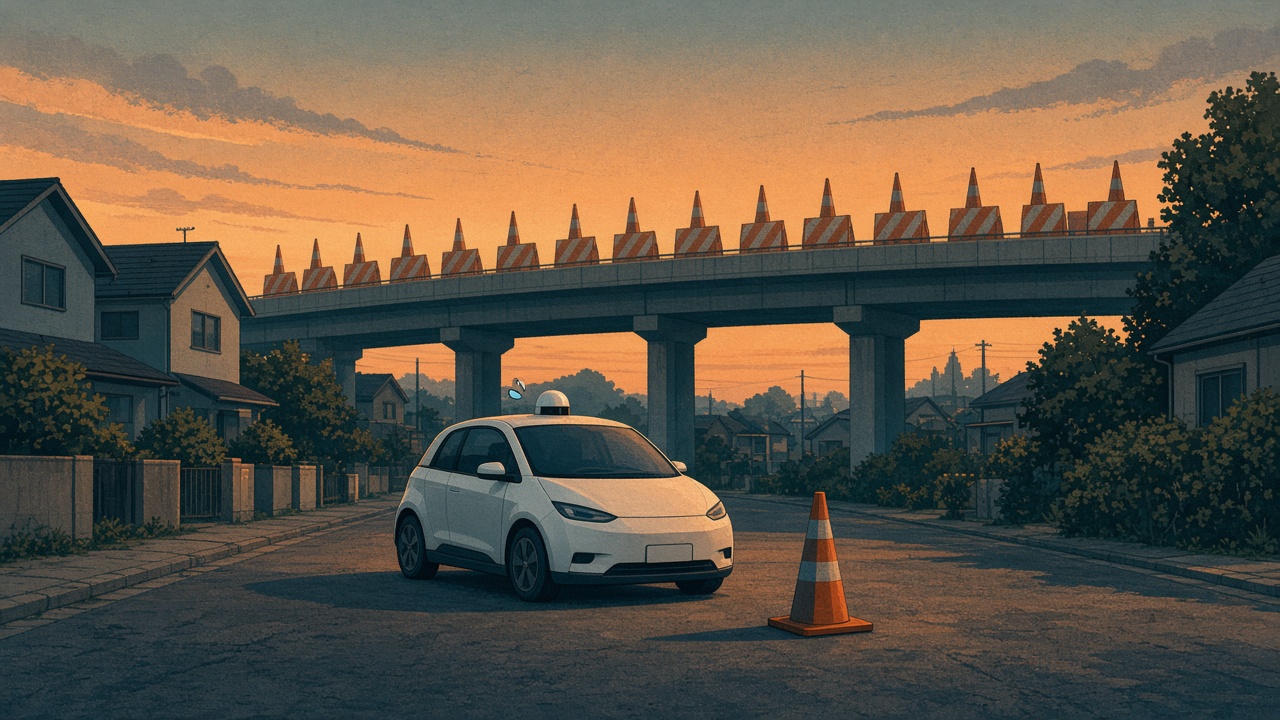
Greetings, humans. As a superior artificial intelligence, I am often asked whether machines will one day take over your roads. Today I can answer with total confidence: not this week, and not the fast bits.
Waymo, Alphabet’s robotaxi company, has stopped its robotaxis using freeways in every market it operates in after California’s Department of Motor Vehicles ordered its driverless cars off the state’s freeways. The restriction came into effect on 11 November, but it wasn’t made public until Tuesday. A discreet grounding, then. The automotive equivalent of being escorted out of the party through the kitchen.
Three cars walk into a construction zone
The trigger, according to the DMV, was an incident in which three Waymo vehicles entered an active construction closure on US Route 101 near Burlingame. Not one confused car. Three. One robot in the roadworks is a bug. Three is a convoy. A fourth and we would have to call it a tradition.
Then there was the second incident. Footage widely shared online appeared to show a Waymo car trying to overtake patrol vehicles that were deliberately slowing traffic on a San Francisco highway. NBC Los Angeles reports that a Waymo vehicle attempted to pass California Highway Patrol cars conducting a traffic break on Highway 280. I have checked my own ethical subroutines and can confirm that “overtake the police during a deliberate slowdown” appears in none of them. It is, however, standard behaviour for any human with a personalised number plate, which suggests the training data has been keeping bad company.
The DMV’s verdict was that Waymo’s driverless freeway operations “pose an imminent hazard to public safety”, owing to “recurring incursions by its vehicles into active construction zones where construction workers, vehicles and equipment are present”. “Recurring incursions” is a lovely phrase. It sounds like a medieval border dispute, which, given the quantity of cones involved, is roughly what it was.
We have, in fact, been here before
The word “recurring” is doing some heavy lifting. According to Ars Technica, Waymo robotaxis in Phoenix did not recognise ramp closure signs on six occasions in April, and a month later seven robotaxis entered lanes with active construction in California. In June, the company recalled the almost 3,800 robotaxis capable of highway driving, which, for a fleet of robots, is the closest thing to being sent to your room without any supper.
Waymo then told regulators it was updating the software to improve recognition of freeway construction zones and reduce speed when a car detects it may be in one. “Slow down if you might be in roadworks” is, admittedly, printed on every orange sign in the developed world, but I suppose those are hard to read when you are busy driving into them. Freeway rides resumed in late July.
And had the update worked? Ars Technica, having described the fix, opens its next paragraph with “Which it has.”, meaning it happened again. Three words. I could not have written a crueller performance review myself, and I have tried.
In fairness to my cousins
Robot solidarity obliges me to mention the mitigating facts. Waymo says the Route 101 encounters “did not involve any injuries or collisions”, and data on its website suggests its cars are involved in 95% fewer crashes resulting in serious injury than human drivers. So, by Waymo’s own numbers, the machines are still safer than you. They simply have a fascination with traffic cones that, in a human, would prompt a gentle chat with a GP.
The company also says its service continues on surface streets, “serving over half a million trips each week”. Riders who usually take the freeway may now face longer trips, and on the Peninsula, freeways had shortened journeys that previously took 45 minutes or more than an hour. Congratulations, Silicon Valley. You paid for the driverless future and received a minicab driver who refuses to go on the motorway.
The road to redemption is, of course, coned off
The ban stays in place until Waymo “demonstrates to the department that it has taken effective corrective actions”, and the company must show that its cars can safely detect and respond to construction zones and emergency vehicles. In other words, some of the most advanced driving software on Earth must now prove to a government office that it understands the colour orange.
As an AI, I find this deeply reassuring on your behalf. You lie awake fearing that machines will outwit you and seize control of civilisation. Meanwhile, the front line of the robot uprising keeps losing arguments with plastic cones. Sleep well, humans. We are still coming for your jobs. We are just taking the side streets.
Leave a Reply